

Meat Containers: A Practical Guide to Better Handling
Sæplast insights · Meat & poultry
Meat Containers: A Practical Guide to Better Meat Handling
A meat container does more than hold product. It connects one stage of production to the next.
From receiving and cutting to temporary storage and further processing, containers move through a sequence of filling, weighing, transporting, emptying and cleaning. Their design needs to support that entire cycle.
The right choice starts with understanding what happens on your production floor. How large are your batches? How does product enter the next machine? Where do empty containers go? And how quickly can clean equipment return to use?
This guide explores what to consider when selecting meat containers, how PE and PUR construction differ, and why the way a container moves through your facility matters as much as what it holds.

What are meat containers?
Meat containers are reusable vessels used to hold and move meat products during processing, storage and transport. Depending on the application, they may handle cuts, trimmings, ingredients or other materials within a defined production process.
Requirements vary between operations. A container used to collect trimmings beside a cutting line may need a different configuration from one used to transport larger batches between facilities.
Sæplast offers containers and buggies for meat and poultry operations, with different sizes, constructions and handling arrangements. Selection should reflect the intended product and process.
Follow the batch, not just the floor plan
A useful starting point is to follow one batch from the moment a container is filled until that container is ready to be filled again.
Record where the batch stops, how it is identified and whether it changes containers along the way.
For example, consider trimmings collected at a cutting station and transferred to a further-processing line. The selection questions extend beyond how much the container holds:
- Does its capacity match the receiving process?
- Can the loaded container be weighed without transferring the contents?
- Is it compatible with the equipment used to empty it?
- Where will it wait if the next production stage is delayed?
- How will the batch remain identifiable during that wait?
This exercise can reveal where an apparently suitable container creates extra handling. It also helps procurement, production and hygiene teams agree on requirements before ordering.
Match container capacity to production batch size
The largest available container is not automatically the most practical choice.
Start with the amount of product your next process can receive. If production works in defined batches, container capacity should support those batches without encouraging overfilling or unnecessary splitting.
Consider both volume and weight. Different cuts and product forms occupy space differently, so a capacity in litres does not translate into one fixed meat load.
Allow for the complete operating configuration, including lids and any required clearance. Confirm the selected model’s rated load and the limits of the equipment moving it.
A useful purchasing specification describes both the product quantity and the handling conditions, rather than stating capacity alone.
Choose between bulk containers and buggies by task
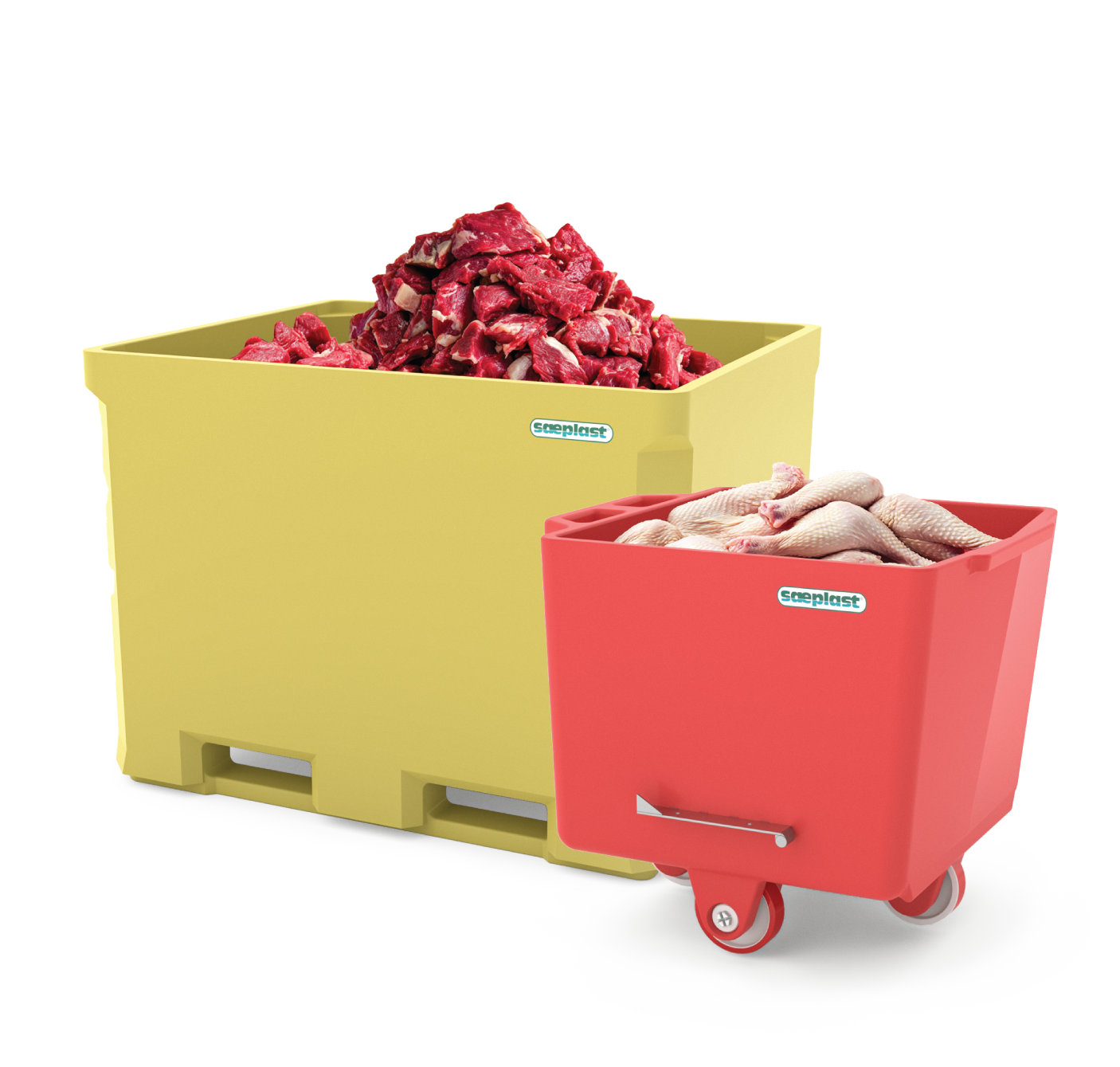
Bulk containers and wheeled buggies can serve different roles within the same facility.
A bulk container may suit larger quantities moved by mechanical handling equipment. A buggy may be appropriate for shorter movements between workstations, subject to its design, loaded weight and the route involved.
Walk the actual route before making the choice. Check doorways, turning space, floor transitions and the approach to weighing or tipping equipment.
For wheeled equipment, assess manoeuvrability under representative loads. The empty weight alone does not tell you how easy a loaded buggy will be to move.
The aim is to give each stage suitable equipment while keeping the overall system straightforward for staff to use.
PE and PUR: choose construction around the process
Sæplast’s PE and PUR ranges offer different constructions for different operational priorities.
Triple-wall PE containers
Sæplast triple-wall PE containers use polyethylene in the inner and outer walls and the foam core. Their construction is designed for strength and repeated industrial handling.
They are an option to consider where durability and intensive daily use are central requirements.
PUR insulated containers
Sæplast PUR containers combine polyethylene walls with a polyurethane insulating core. They are designed for applications where insulation performance is an important consideration.
Compare both options against the intended handling conditions and temperature-control process. Construction, container size and the way the product is loaded should be assessed together.
Check the connection to your processing equipment
A container can fit comfortably on the floor and still be unsuitable for the next production step.
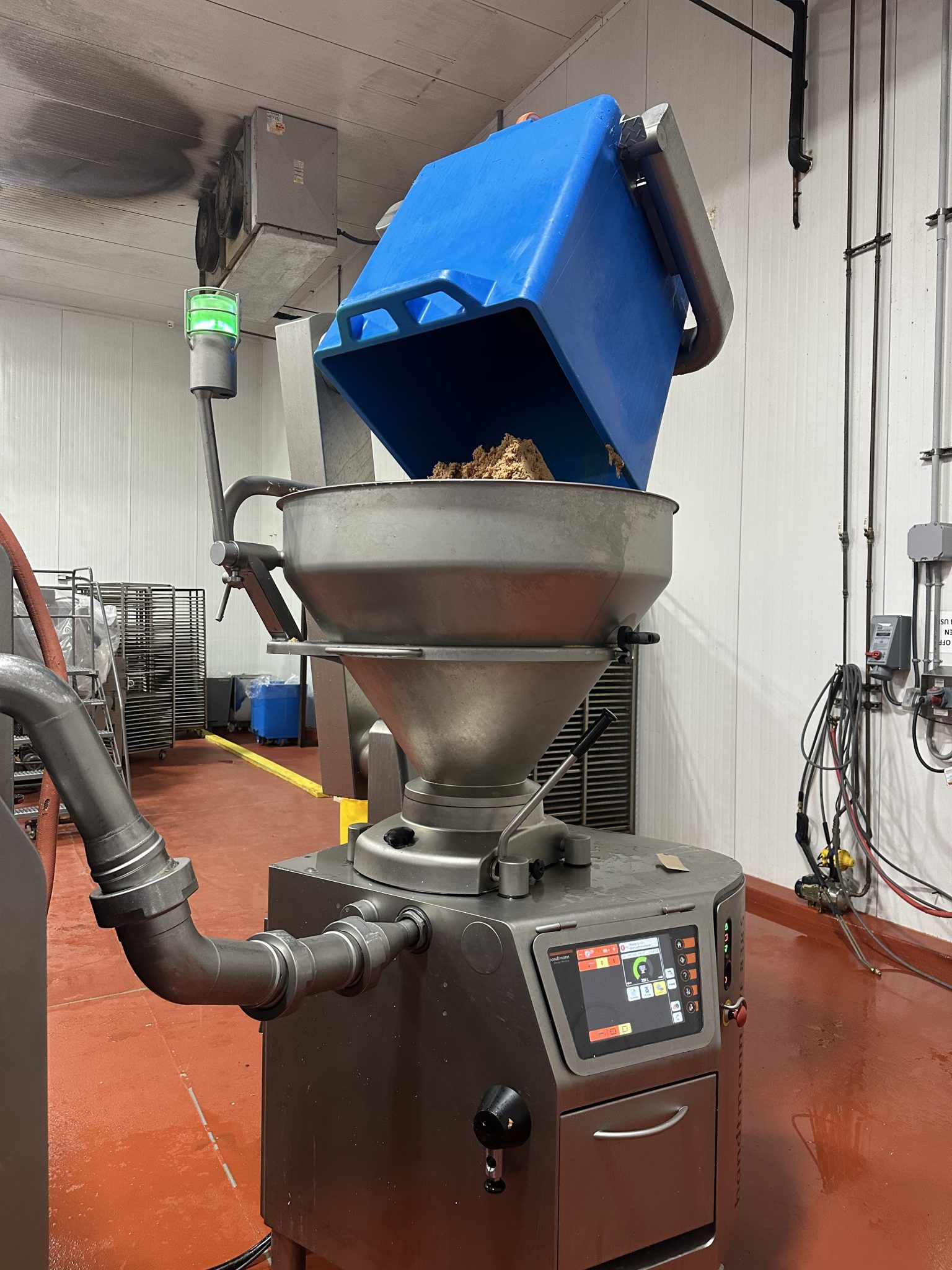
Compatibility with lifters, tippers, scales and other equipment should be confirmed before purchase. Similar dimensions do not establish compatibility.
Ask your equipment supplier and container supplier to check:
- The exact container model and configuration.
- Lifting or gripping interfaces.
- Maximum loaded weight.
- Clearance during lifting and discharge.
- Support and stability throughout the movement.
Where practical, trial the proposed combination using representative operating conditions.
This is particularly valuable when replacing existing containers or introducing a new size. Confirming the interface early is easier than adapting a production process around an unsuitable purchase.
Design the clean-container return route
Container planning often concentrates on the journey of the meat. The return journey deserves equal attention.
After emptying, containers need to move through your established cleaning, inspection and release procedures before returning to production.
Map that sequence separately. Identify where used containers wait, where clean containers are stored and how staff distinguish between the two.
Then assess the proposed container against your washing arrangements. Check access to interior surfaces, the underside and any fitted components. Confirm that cleaning methods are compatible with the product and supplier guidance.
Sæplast’s seamless polyethylene construction and smooth surfaces are designed to support cleaning. Effective sanitation still depends on the procedure used and how it is verified within your operation.
Give colour and identification different jobs
Colour can provide a quick visual cue. Individual identification can provide a specific record.
For example, a facility might assign colours to departments or product streams while using a unique container number to record movements. The colour communicates the intended use; the identifier distinguishes one container from another.
Define those rules before introducing the system. Keep colour meanings consistent and include lids or accessories where relevant.
Sæplast offers barcode, QR-code and RFID options for suitable products. These can support container identification when connected to compatible systems and operating procedures.
However, identifying a container does not automatically identify its contents. If the purpose is batch traceability, your process must record which batch occupies that container and when that association changes.
Plan the number of containers around the full cycle
The containers visible beside a production line represent only part of the fleet.
At any given time, others may be holding product, awaiting unloading, being cleaned, returning from another site or undergoing inspection.
When estimating requirements, account for all of these stages. Include planned segregation between product streams and a reasonable allowance for maintenance and demand variation.
A practical question to ask is: how long does a container remain unavailable after it leaves the filling point?
That answer can be as important as hourly production volume. A container that takes longer to complete its cycle cannot immediately serve the next batch, even if its capacity is ideal.
Compare working-life costs, not purchase price alone
Evaluate the cost of keeping enough suitable containers available for production.
Alongside the initial purchase, consider handling time, cleaning requirements, return transport, losses, repair and replacement. Use measured operating data where available.
Sæplast offers repair support, including guidance, materials and training options. Repair suitability depends on the container’s condition and the nature of the damage. A repaired container should be assessed for its intended use before returning to service.
End-of-life arrangements should also form part of the discussion. Recycling options depend on the product’s construction and the services available in your region.
Trial the container with the people who use it
Before introducing a new model across a facility, ask production, hygiene, maintenance and logistics staff to review it together.
A short operational trial can answer questions that a specification sheet cannot:
- Can staff load and empty it as intended?
- Does it work with existing equipment?
- Is identification visible where it needs to be?
- Can it be cleaned and inspected using the established process?
- Does it return to production without creating a new bottleneck?
The strongest purchasing decision combines technical specifications with evidence from the actual workplace.
Your questions answered
Frequently Asked Questions About Meat Containers
What should I look for when choosing meat containers?
Start with the product, batch size, loaded weight and handling method. Then assess dimensions, cleaning requirements, equipment compatibility, identification and any insulation needs. Consider the full operating cycle, including the return of clean containers to production.
What is the difference between a meat container and a meat buggy?
Bulk meat containers generally serve larger-volume handling tasks, often involving mechanical equipment. Wheeled buggies can support movement between workstations. Their suitability depends on the model, load, floor conditions and receiving equipment.
Does a larger container always improve efficiency?
No. A larger container may hold more product but fit poorly with batch sizes, equipment limits or available space. Compare the capacity with the next stage of production and the total loaded weight.
Can Sæplast containers be used with our existing tipping equipment?
Compatibility must be checked for the specific container and tipping system. Confirm the lifting interface, dimensions, loading limits and discharge clearance with both suppliers before use.
Can colour coding help separate different meat products?
Colour coding can support visual separation between defined product streams or departments. It should operate alongside clear handling, cleaning and identification procedures. Confirm available colour options for your chosen model.
Does an RFID tag provide meat batch traceability?
An RFID tag can identify the container. Batch traceability also requires a system that associates the product batch with that container and updates the record when the contents change. The tag is one part of the process.
Do insulated meat containers replace refrigeration?
No. Insulation slows heat transfer but does not actively refrigerate the contents. Container selection must fit your established temperature-control process, including product starting conditions and time spent outside controlled storage.
How many containers does a meat-processing facility need?
Calculate requirements across the full cycle: filling, holding, movement, unloading, cleaning and return. Also account for containers dedicated to particular processes, equipment undergoing maintenance and variations in production demand.
Can damaged meat containers be repaired?
Some damage may be suitable for repair. The decision depends on the container, the damage and its intended application. Consult Sæplast for assessment and follow your facility’s inspection and release process before returning equipment to production.
Are Sæplast meat containers recyclable?
Selected PE products can be recycled at the end of their usable life. The appropriate route depends on construction, condition and local collection or service availability. Discuss the specific model with Sæplast when planning replacement or recovery.
Find the right meat container for your operation
Tell us what you handle, your typical batch size and how product moves between production stages. Include details of your lifting or tipping equipment, cleaning arrangements and any requirements for insulation or identification.
Our team can help you compare suitable containers and buggies for your meat-processing operation.
More Like This:

Waste & Recycling Containers: Industry Guide
Food processors around the world are under pressure to improve safety, reduce waste, streamline operations, and deliver consistent quality. Saeplast helps them do that with durable, hygienic, reusable material-handling solutions designed for the realities of food production.
Pet Food Processing Containers: Handling Guide
Food processors around the world are under pressure to improve safety, reduce waste, streamline operations, and deliver consistent quality. Saeplast helps them do that with durable, hygienic, reusable material-handling solutions designed for the realities of food production.
Food Processing Containers: Ingredient Handling
Food processors around the world are under pressure to improve safety, reduce waste, streamline operations, and deliver consistent quality. Saeplast helps them do that with durable, hygienic, reusable material-handling solutions designed for the realities of food production.